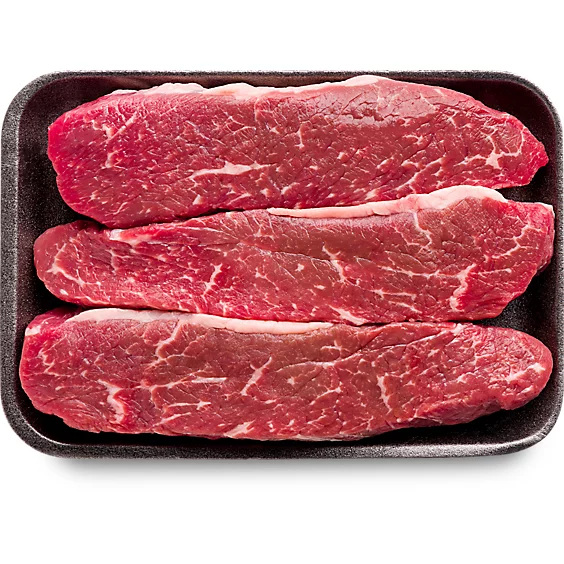
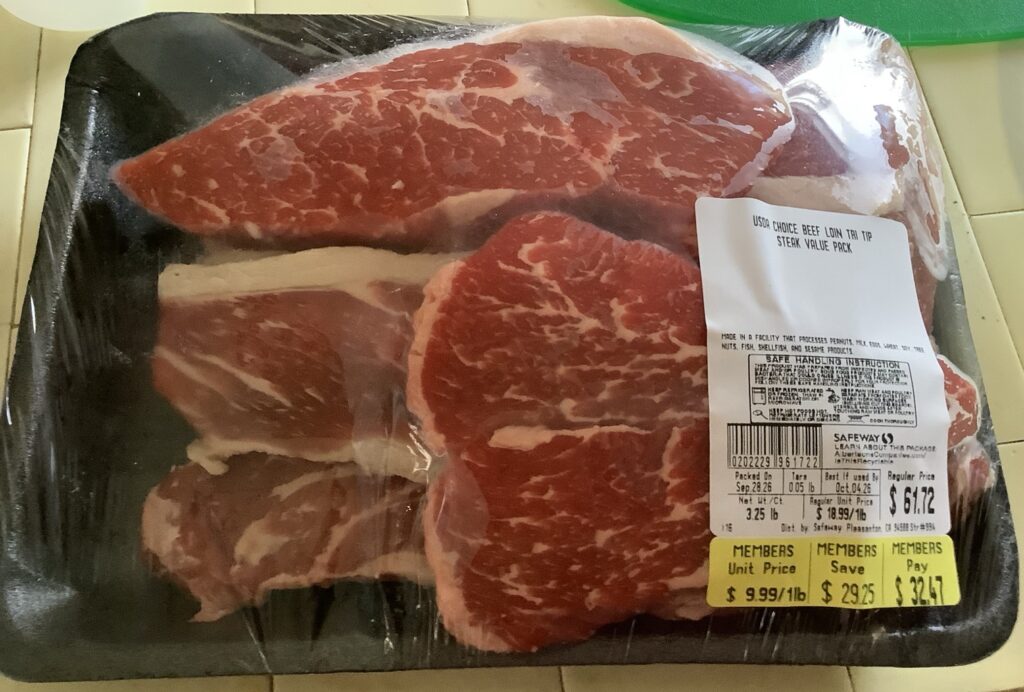
Tri-tip, that so-very California cut, was on sale at Safeway last week. It was $7/lb for the untrimmed roast and $10/lb for the steaks (down from $19/lb regular price). Last time I got the roast, it has almost as much fat as meat, so I decided to give the steaks a try this time. In the photo on their website, the steaks looked trimmed. I had bought this cut before in the past, and had worked quite well.
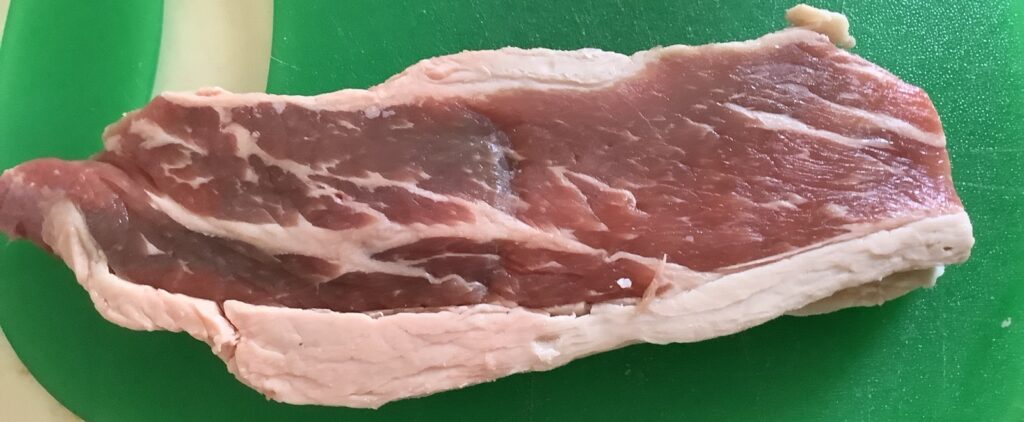
Alas, instead of getting three trimmed tri-tip steaks, I got a bunch of untrimmed smaller steaks. Here is the picture of just one:
I did trim them before grilling them, but the flavor was also sort of off – not as having gone bad, but just not having the great flavor that tri-tip usually has. I’m not an expert on beef, but I wonder if Safeway is getting worse quality meat to be able to put it on sale. The problem is that not knowing whether this is the case, makes me feel reluctant to buy it at regular price as well.
Now, don’t get me wrong, in these times when beef is so astronomically expensive, I very much appreciate Safeway’s sale prices, which I suspect may be loss leaders – but I also want to get what I think I’m ordering.
Tri-tip is a very Californian cut of meat, it comes from the “bottom sirloin sub primal” and it has a very distinctive triangular shape. It’s a very lean cut of meat, but quite tender, and can be grilled, roasted, slow cooked with bbq sauce or even thinly sliced for everything from bulgogi, to beef Stroganoff to stir fries. In California, you can usually buy either trimmed – with the otherwise thick layer of fat surrounding it removed – or untrimmed. The untrimmed version often goes on sale at my local Safeway, which makes it a very tempting cut to get during these times when meat prices are through the roof.
I’ve been cooking tri-tip for over twenty years, but it never occurred to me to check whether this cut was used in Argentinian cuisine. So it was only last week that I found out that tri-tip is colita de cuadril, which in Argentina is usually stuffed and then grilled. I don’t think my father ever made it, I don’t have any childhood memories of stuffed meat, beyond matambre, which is actually thin flank steak rolled around the stuffing. Of course, as soon as I ran across these Argentinian colita de cuadril recipes I wanted to ask my dad about it, but he passed away a couple of years ago. Alas, I did write about it on Facebook and tagged him – and a couple of his friends responded telling me about it. That was very sweet, and I’m writing it down here so I can remember how nice it felt.
In any case, I had bought a twin pack of tri-tip roasts on sale and had used one to make Floribbean Tri-tip Roast with Chimichurri Verde, so I had another one already trimmed and ready to be stuffed. There are many ideas for stuffings online, and this one sounded particularly good. I did adapt it considerably to account for my taste and ingredients available in California (in other words, I did not use blood sausage).
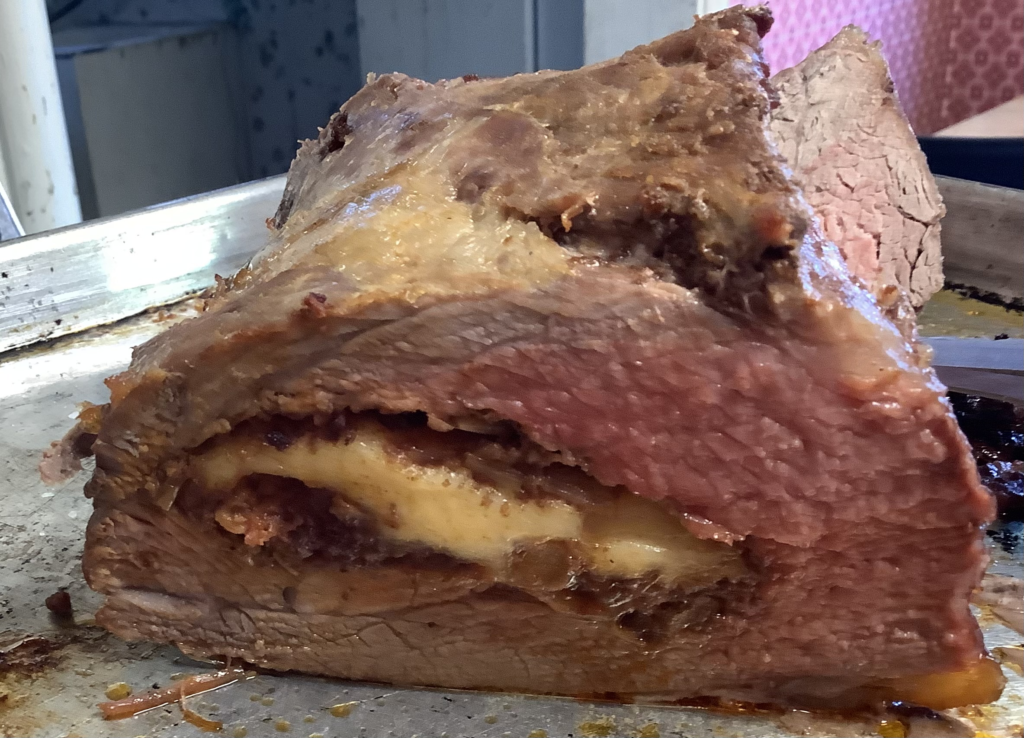
I roasted the tri-tip rather than grilling it, and I overcooked it (you might want to cook it for 30 minutes total and check to see if it’s done), but overall it was a very tasty dish and I would make it again – though what I really want to do is experiment with different stuffings, so if tri-tip continues to be on sale this summer, you can expect more recipes.
The hardest part of making stuffed tri-tip is cutting the tri-tip. You want to cut as wide and deep a hole as you can without opening up any sides. I found that cutting a couple of inches deep at a time worked best. But I also found that I didn’t have a knife long enough to go all the way to the end, and my hand was too big to get inside it. I think I might invest in a long knife for future tri-tips.
Ingredients
1 tri-tip roast
1 tsp olive oil
3 thick bacon slices, cut into 1/2″ pieces
1/2 onion, chopped
1 large leek, trimmed and white and stalk thinly sliced in semi-circles
salt & pepper to taste
1 small apple, diced
1 9oz Mexican chorizo
4 – 6 oz fresh Mozzarella, cut into big chunks.
Directions
Preheat oven or grill to 300°F.
Trim excess fat from both sides of the tri-tip. Make a wide incision on the center of the larger end of the tri-tip and cut across the wide side, being careful to not pierce the sides. Continue cutting deeper and deeper, as wide as you can without piercing the sides and as far as you can get. Set aside while you prepare the filling.
Heat oil over medium heat in a sauté pan. Add the bacon bits and cook until the fat is rendered, about 5 minutes. Add the onion and cook until it starts to soften. Add the leek and cook for a couple of minutes. Season with salt and pepper to taste. Add the apple and cook for a couple more minutes. Remove the chorizo from its casing and add to the sauté pan. Continue cooking, stirring frequently, until the chorizo is cooked through.
Stuff the tri-tip alternating between Mozzarella chunks and stuffing, going as deep into the tri-tip as possible and filling it up as much as you can. If you are grilling it, tie the roast shut with kitchen string.
Transfer roast to a baking sheet and roast in the oven for about 15 to 20 minutes per side. Alternatively, place on the grill over indirect heat and cook for about an hour, turning half way.
This year, we stayed home for Thanksgiving. That meant that I would be making dinner, and I was just not at all inspired this time around. It took me forever to come up with a menu – I finally settled on a seasonal French-inspired menu – and then I completely failed in its execution. There wasn’t anything wrong with the recipes, several of which I’d cooked before, but my timing was off, dishes were unbalanced and I just couldn’t deliver. Still, I do like to know what I’ve done in previous years, so here is what I cooked.
1 – Canapés
Smoked Salmon and Cream Cheese on Crackers
Tri-Tip and White Cheddar with Horseradish Cream Crostini
Baked Camembert with Honey and Rosemary with crackers
I decided near the last minute to serve a few canapes, as I had invited my friends Lola and Iggy for dinner rather early and I wanted them to have something to eat while I prepared the dinner in the kitchen. I chose things that didn’t require much effort to put together, and they all worked wonderfully.
For the salmon canapés, I simply spread cream cheese on crackers and topped these with slices of refrigerated smoked salmon I got at Safeway. I don’t eat salmon, but everyone liked them. I was inspired by Panera’s steak and white cheddar sandwich for the tri-tip canapé. I had previously toasted some tri-tip in the oven, and I simply made thin slices, which I topped with a slice of white cheddar. I don’t remember what recipe for horseradish cream sauce I used, but there are lots of online and I know I chose one of the simplest ones. It was delicious, and I will be sure to make more of these in the form of sandwiches next time I can get tri-tip on sale. Finally, the baked camembert was just delicious.
This turned out to be OK to good. I had made the dressing the day before and I didn’t like it at all, perhaps because I put too much garlic – but it was OK on the salad. My guests did enjoy the pears in particular.
This is where things started to go sour. Rather than make a French Onion soup and simply used vegetable broth instead of beef broth, I went with a recipe that enhanced the flavor of the broth with tamari and other seasonings. The results were not tasty. The soup was very intense – though I solved this by adding extra water when I reheated it – and just not that good. Next time, I’ll stick to the traditional recipe or simply serve a different soup altogether.
I had made this recipe before and it had been delicious, but this time it just didn’t work. I’d doubled the sauce and vegetables but there were just too many vegetables and they weren’t well integrated with the sauce. I’d made an effort to get organic, free range chicken and somehow it was dryer than the chicken I usually buy. I don’t know, it was fine but not great. I did enjoy the leftovers, however.
I made this for my vegetarian daughter, but it was too alcoholic tasting for her, and the flavors were really not well balanced. Another failure.
Sage Stuffing
I also don’t remember what recipe I used, but it was a pretty standard vegetarian one. It was actually not bad, but I did overcook it so it was dry. Still, my vegetarian daughter liked it
Mashed Potatoes
I’m sad to report that, together with the canapes, the mashed potatoes were everyone’s favorite part of the meal. I’m sad because these were just plain mashed potatoes: yukon gold potatoes boiled and mashed and then mixed with a ton of butter and whipping cream.
This is a French apple tart with a custard topping. My daughter actually put this together for me while I was taking a nap. The top was very good, but I had messed up the dough when I’d made it and it was way too tough.
After 12 years (yes, 12 years), I have finally arrived at the “Fs” in my international cooking project. And, of course, that means I must cook classic French food. Finding classic French recipes is not as easy as it sounds – I have already explored several French regional cuisines and I don’t like repeating dishes.
I was happy when I came upon a recipe for steak Diane. I don’t know why I immediately assumed it was a classic French recipe. Maybe it was the name? The ingredients? Though, as my 10-year-old daughter pointed out after a couple of bites, this dish is very close to the beef Stroganoff I’d cooked earlier in the week. In any case, I made it, we enjoyed it, and it wasn’t until I started writing the recipe up that I took a look at its origins – only to find out that it’s an American invention.
Never mind, it was pretty easy to make and the kids enjoyed lighting the pan on fire. Indeed, it lit on its own: the instructions said to tilt the pan away from you and light the alcohol with a match, but when I tilted it, I splashed some liquid on the burner (I have a gas stove) and suddenly the pan was ablaze.
The recipe I used came from the great Emeril Lagasse. The key to making this dish is having each component ready and easily accessible from the stove top. I used tri-tip as it was 1/3 the price of tenderloin, but it was too tough for this cooking method (it was better on the Stroganoff, as it was thinly sliced for that recipe). I’d like to try it with tenderloin, though sirloin might be an alternative. Instead of the “reduced veal stock” the recipe asked for, I used a combination of water/whine and stock concentrate. If you still want to have the flavor of veal, but don’t want to make the stock yourself, Cook’s Delight has a veal base. Finally, “someone” dropped my dish with the chopped parsley/green onions on the floor so I wasn’t able to serve them on the steak. Still, it was delicious.
Place the water, red wine and beef base in a small cooking pot. Cook over medium heat until the base dissolves completely, stirring occasionally. Set aside.
Season the beef with salt and pepper.
Melt the butter in the saute pan over medium-high heat. Add the beef and brown on one side for 45 seconds. Turn and cook for 30 seconds. Add the shallots and garlic and cook for 20 seconds. Add the mushrooms and cook for an additional two minutes. Remove the steak to a warm platter and cover with foil. Continue cooking the mushrooms until soft, a couple of more minutes.
Add the cognac and lit the pan on fire. Keep on the stove until the flame burns out and then add the cream and the mustard. Mix well and cook for one minute. Add the beef stock and cook for another minute. Add the Worcestershire sauce and mix. Return the medallions and the accumulated juices to the pan and turn to coat.
Before serving, sprinkle with the green onions and parsley.
Yesterday we had a BBQ in honor of Mike’s birthday. I didn’t make anything new, but IMHO what I made was quite good and would recommend it for your (or my) next BBQ. Lola brought the salad, and I served chips with salsa and guacamole and my great potato salad, but otherwise all there was was protein (and birthday cake):
-Hot dogs
-BBQ chicken
–Thyme marinated tri-tip
–Tofu Satay
I trimmed and coated the tri-tip with coarse salt before marinating it, and it came out perfectly.
I served the tofu satay plain (without peanut sauce), but my vegetarian (and non-vegetarian) friends loved it – so much so that they took the leftovers to grill at home 🙂 I didn’t have Madeira wine for the recipe this time, so I used port instead.
London Broil is the name given to top round in California. It’s a very lean, very tough cut of meat. I used to use it to make a tomato-sauce based stew, that cooks just for under an hour, and it was quite good for that. But I’ve always been weary about grilling it because of its toughness. Still, the times are tough and, like everyone else, I want to save money. And London broil is ridiculously cheap right now – last week it was under $2 lb – so I wanted to cook it. I found this recipe at epicurious.com which got raves. Alas, thinking back, given all the ingredients for the marinade, the final dish is not necessarily cheap, but other than the beef, I had everything else saved for the lemons. In any case, the meat was VERY yummy, I loved the tangy flavor given by the marinade. I’d use it with london broil again. The key is to marinade the meat OVERNIGHT, any less and it won’t get enough flavor. Note that I’m writing the quantities needed to make HALF of the quantity that the original recipe makes – the original recipe says to keep half to serve as a sauce, but I found the sauce too tangy to go with either the beef or the couscous I served with it. I’d just skip it. The quantities below should be enough to marinate a 2lbs (or even bigger) chunk of meat. You can use flank, tri-tip or other similar cuts in addition to top round. Ingredients
1 lemon
1/2 onion, finely chopped
2 cloves garlic, finely chopped
1/2 cup soy sauce
1/4 cup distilled white vinegar
1/4 cup vegetable oil
2 bay leaves, crumbled
1 1/2 tsp. coriander seeds
1/2 tsp. black pepper
Juice the lemon and then chop the rind. Put in a medium size bowl and add the rest of the ingredients. Mix well.
Put the meat your are using in a large, sealable plastic bag and pour in the marinade. Marinade overnight, turning from time to time.
Today I had a BBQ and made this marinade from an epicurious.com recipe. I thought it was quite yummy and somewhat reminiscent of chimichurri. I’d make it again.
3 Tbsp. fresh thyme leaves
1 1/2 tsp. dried oregano
1 tsp. kosher salt
2 garlic cloves
2 Tbsp. lemon juice
1/2 cup olive oil
Put thyme, oregano, salt and garlic is a mini-chopper. Process until garlic is finely chopped. Add lemon juice and process until well mixed. Repeat with olive oil.
Marinade tri-tip in the sauce for at least 2 hours.
I made this tonight, from an epicurious.com recipe. I used tri-tip steak instead of tenderloin ($3 lb vs. $11lb at Safeway), and the steak came out very nice, tender enough and tasty. That said, I’ll probably not make this recipe again (unless I have some hoisin sauce I need to get rid of), because while good, it wasn’t special enough.
Safeway has been periodically having tri-tip roast on sale for something like $3-4 a lb. Pretty cheap, all in all. It’s not the tastiest of cuts, specially the Safeway brand which emphasizes tenderness over flavor, so I looked for a recipe that would infuse some flavor in it. This recipe for Hoisin-Marinated Tri-Tip Roast sounded pretty good and it got good reviews. Alas, it wasn’t as good as I’d hoped. The outside of the meat was nicely caramelized and very tasty, but the flavor didn’t make it all the way through. I don’t think I’d bother making it again.
Last night, and agains today for lunch, we had “Rancher’s Reserve” tri-tip, grilled on the BBQ. Rancher’s Reserve is select grade meat (i.e. fit for human consumption) that for whatever reason is supposed to be more tender than it should. And indeed it is. Flavor wise it’s clearly inferior to Costco’s choice meat, but it is probably just as tender. I’d probably buy it again if I couldn’t get Costco beef.
 . Finally, “someone” dropped my dish with the chopped parsley/green onions on the floor so I wasn’t able to serve them on the steak. Still, it was delicious.
 )
)













Recent Comments