One name, two types
Chile peppers originated in South America, but they spread throughout the world pretty much as soon as the Europeans and Portuguese got a hold of them. There are 22 species of wild peppers and 5 domesticated ones, but within those five there are thousands of varieties, with differing amounts of of sweetness, fruitiness and spiciness. Most of us, however, have access to only a handful of fresh peppers – those of the varieties most commonly grown where we live – and only a handful more of dry peppers. This means, that when we cook dishes from other countries and regions that call for peppers, figuring out what local pepper to substitute is a challenge.
One common pepper that shows up in Luso cuisines, those from countries once colonized by Portugal, are peri peri peppers. Also known as piri piri or African Bird’s Eye, these are cultivars of Capsicum frutescens. They are young, small and very hot but still red peppers, that will apparently develop into Malagueta peppers as they grow. They particularly prized in Africa and used in many dishes directly or as peri peri sauce. While you can get the sauce in many places in America, including Trader Joe’s, which imports it from South Africa, getting the pepper itself is much harder.
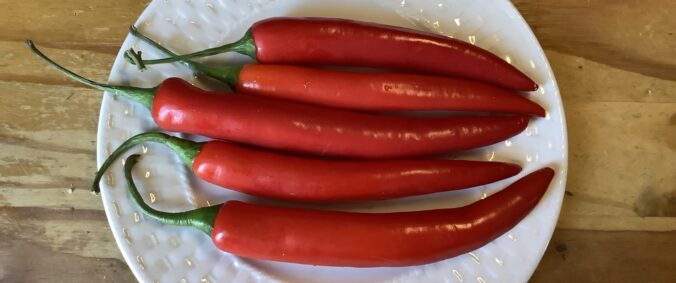
One suggested alternative for recipes that call for peri peri peppers are Bird’s eye chiles, aka Prik Kee Noo, an Asian chili which is also small and very hot. It’s used prominently in South East Asian cuisine. Indeed, peri peri peppers are supposed to be a subcategory of bird’s eye chiles. In America, bird’s eye peppers are often called Thai peppers. And, indeed, if you order green Thai peppers at Safeway (or at least my Safeway), that is what you usually get. Now, red Thai peppers are simply the ripe stage of Thai peppers, so they are usually larger and less spicy than the green kind. But at Safeway, the red Thai peppers they sell are actually Thai spur chilies. Now bird’s eye chiles and Thai spur chilies are both species of Capsicum annuum – as are bell peppers -, but the latter is much larger and less spicy than the former, which makes it not really a suitable alternative for peri peri peppers. It looks easy enough to get dried red bird’s eye peppers, and it might be possible to get fresh ones from Facebook Marketplace or Asian supermarkets. Or, I guess, to just use green ones.




















Recent Comments