The United States and Mexico are historically, culturally and geographically linked - a fourth of the current US territory was once Mexico. Indeed, a little over a tenth of the US population or about forty million Americans, see themselves as Mexican-American. It thus should be not a surprise to anyone that Mexican food thrives in the US - particularly in the West Coast, the former Mexican territories.
While in recent years, restaurants have surged which serve real regional Mexican food, what we consider Mexican food in the US and what I will call Mexican American food (though it could easily be called American Mexican food), differs significantly from what it's served south of the border. Mexican American food today is a fusion of the cuisine of the original Mexican inhabitant of the former Mexican states that were forcibly annexed by the US, the cuisine of Mexican immigrants and the inventions and innovations of chefs and restaurateurs in the US. It's a constantly evolving cuisine, and one that is now merging with the cuisine of other immigrant populations into new variants. I've cooked K-Mex food before, and I might explore other -Mex foods in the future.
Mexican-American food itself seems to have at least two main variants, Tex-Mex and Cal-Mex, with the former being preponderant. There might even be an argument for a South-Mex, to describe the cuisine created by residents of the American South as they incorporated Mexican flavors. As I will never actually get to "S" in this project, this will have to remain a theoretical proposition. There are, however, a number of dishes that might have originated within one of these sub-cuisines but which have become such a ubiquitous part of the American table - akin to spaghetti with meatballs - that should be best described part of Mexican American cuisine as a whole. These include chili con carne, nachos, burritos, enchiladas and chiles rellenos - you can even get frozen versions of the two latter from mass-market frozen food company Stouffers.
For my brief sojourn into Mexican-American cuisine, I made
Hard Shell Tacos
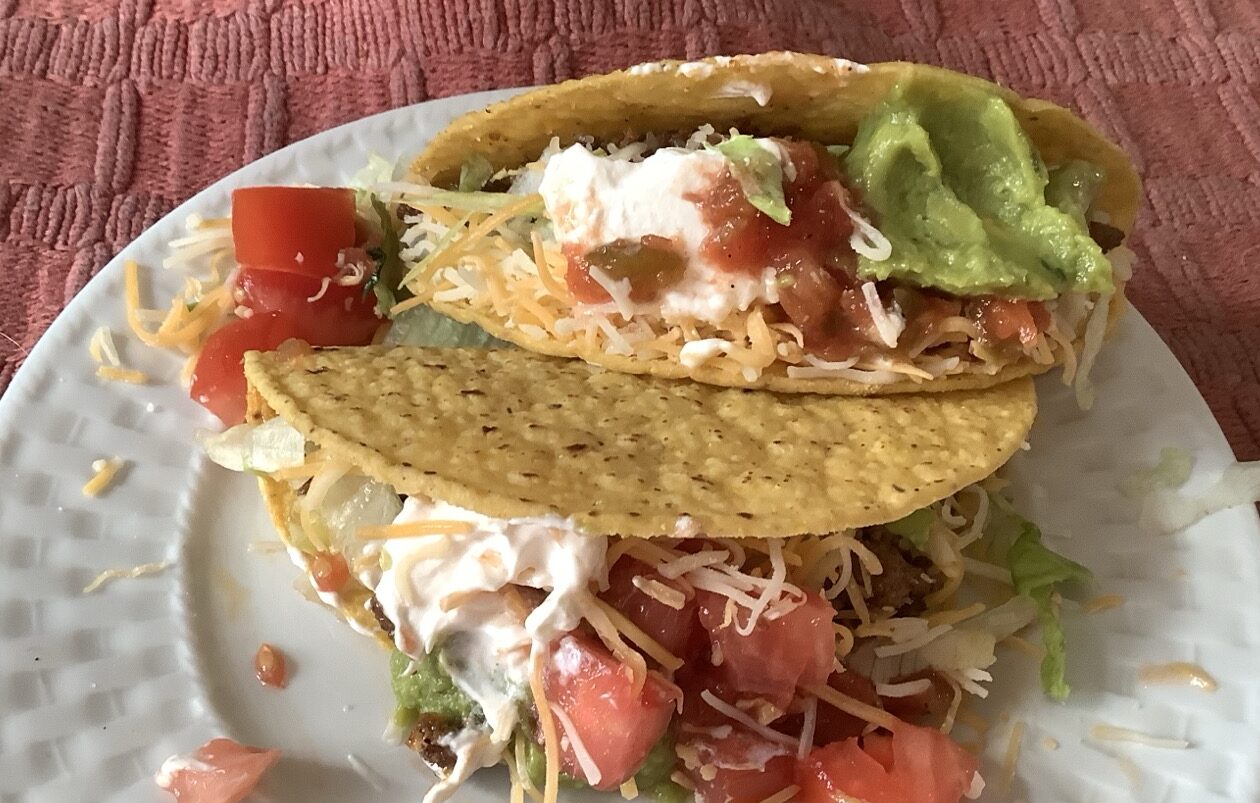
Tacos, a small tortilla with some type of filling, are Mexico's street food par excellence. It was inevitable that at some point someone would think of crisping the tortilla by frying it, and that's how tacos dorados were born. Apparently, these were the first tacos to make their way into the US. By the 1910's you could find recipes for hard-shell tacos in Mexican-Spanish cookbooks and by the 1930's you could buy hard-shell taco molds as well as canned products, including tortillas, to make your own tacos and other Mexican food dishes, at home. But it was white-American Glen Bell, who would introduce hard shell tacos to the masses and made them a staple of American dinner tables throughout the country. As the story goes, in the 1950's, Mr. Bell owned a hot dog stand in San Bernardino, across the street from a taco stand so popular that its owners opened a restaurant, which still stands. Among its specialty were tacos dorados with ground beef, cheddar cheese, tomatoes and iceberg lettuce. Intrigued, Bell convinced the owners to show him how tacos dorados were made and prompted him to open his own taco stand and eventually his own restaurant. It was popular enough that he was able to franchise it and the rest is history.
As Taco Bell became more popular, so did Americans' hunger for tacos - which they now understood as having hard shells. Processed food companies were quick to sell hard-shells that did not need to be fried, as well as salsas and pre-mixed taco seasoning. A taco joint in Montana popularized the notion of Taco Tuesdays, and it took off. After all, tacos are cheap and easy to make and serving them on Tuesdays means not having to think what to make at least one day of the week.
My husband, like many American kids, grew up eating hard shell tacos but I had never had them before. I didn't eat tacos at all before I went to Mexico in the early 1990's, and then I became a taco snob who would only eat soft tacos. So this, to me, was a perfect opportunity to try this American classic.
I made this recipe as I imagined my mother-in-law, who passed away last year, would have made it: as imply as possible. This means I used store-bought shells (rather than frying tortillas), pre-shredded cheese and lettuce, and taco seasoning. Note that commercial taco seasoning is mostly fillers, mostly cornmeal, so if you make your own, you might want to add less seasoning to the meat. You can easily make this recipe vegan by using fake meat and cheese.
My husband felt these tacos were a trip down memory lane - though I used far more seasoning than his mother had (I used 1/2 cup, but I thought it was too much myself, so I'm decreasing it in my recipe). He was quite happy with them, and not only because they made him feel nostalgic. I actually felt they tasted a lot like the nachos I make, which is to be expected as they have most of the same ingredients. I can totally see why they'd be a popular meal among American and Mexican-American families.
PRINT PDF
Hard Shell Tacos
Ingredients
For the filling
- 1 Tbsp olive oil
- 1 onion, chopped (optional)
- 2 lbs ground beef
- 2 Tbsp tomato paste
- 1/3 cup taco seasoning
For the tacos
- 12 taco shells
- 1 cup shredded Mexican cheese mixture
- 1 large tomato, chopped
- 1 cup shredded iceberg lettuce
- salsa, sour cream and/or guacamole to taste
Directions
In a sauté pan, heat olive oil over medium high heat. Add the onion, if using, and cook until soft. Add the ground beef and cook until it starts to brown. Stir in the tomato paste. Add the taco seasoning and half a cup of water. Mix well, bring heat down to medium-low and cook for 10 minutes, stirring occasionally.
Meanwhile, warm taco shells according to manufacturer instructions.
Add the ground beef to the shells. Top with cheese, tomato, lettuce, salsa, sour cream and/or guacamole and sere.
|
Adapted from several recipes
Mexican cuisines I've cooked so far: Aguascalientes, Campechana, Chiapan, Chihuahuan, Cohauilense, Duranguense, Guanajuato, Hidalguense, Jalisciense
American Regional Cuisines: American, Alaskan, Appalachian, Alabamian, Angeleno, Arizonan, Arkansas,
Baltimore,
Californian, Coloradoan, Connecticuter, Delawarean, Floridian, Georgian, Hawaiian, Hoosier, Idahoan, Illinoisan, Iowan, Kansan, Kansas City, Kentuckian, Lowcountry, Mainer, Marylander, Massachusetts, Michigander, Minneapolis, Minnesotan, Mississippian, Missourian, Montanan
Other Ethnic American cuisines: American, Acadians, African-American, Amish, Appalachian, Cal-Mex, Cajun, Creole, Cuban-American, Floribbean, German-American, Hungarian-American, Irish-American, Italian-American, Jewish American, K-Mex, Korean-American, Mexican-American
North-American Indigenous cuisines I've cooked so far:
Choctaw, Cree, Iroquoian, Kiowa
Historical American Cuisines:
Ante Bellum, Colonial, Cowboy
Do you have a comment on this recipe? Please make it here